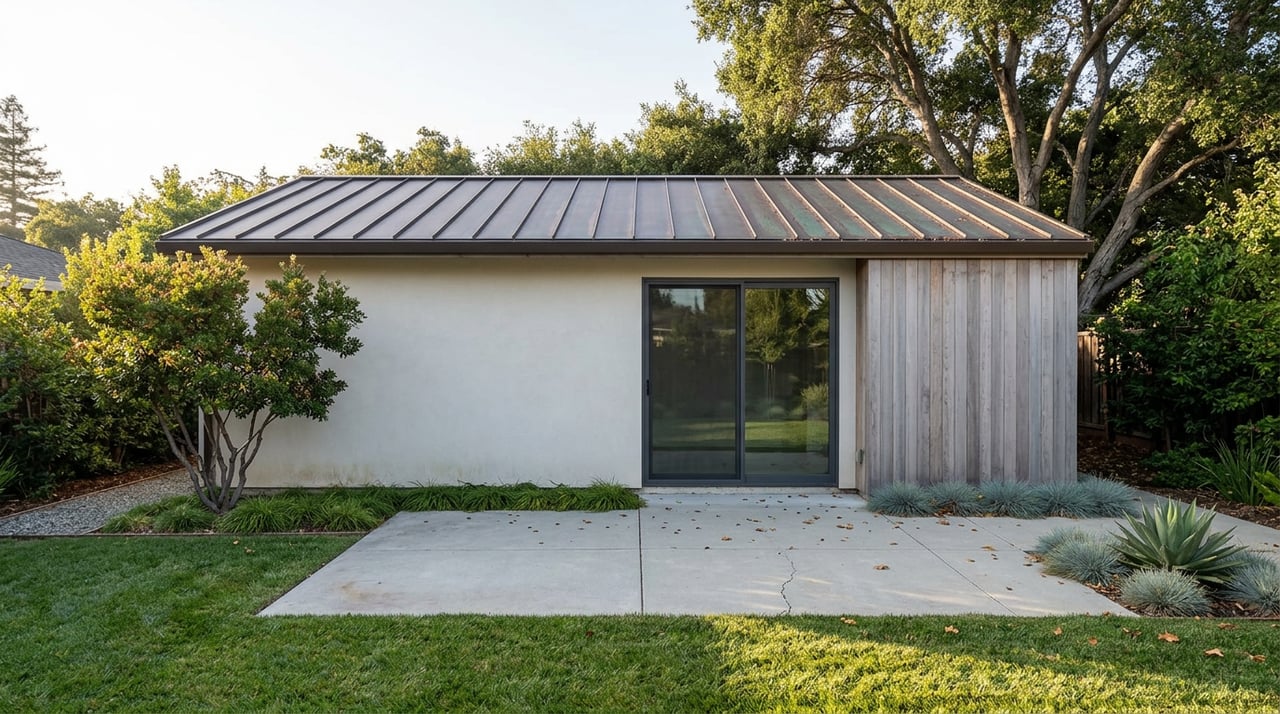
If you're pricing out a detached ADU in San Carlos this fall, here's the question worth asking before you pay a designer a dollar: are you building to state law, or to the city's own rulebook? Right now those two things don't say the same thing about how tall your unit can be, and the gap is not a rounding error. It's the difference between a garage conversion that fits under the roofline you already have and one that requires a redesign.
California law says a detached ADU built within a half mile of public transit, or as part of an existing multifamily building, can reach 18 to 20 feet. San Carlos's own ADU page, last confirmed updated in October 2025, still describes the ordinance as pending a revision to match recent state legislation. The last full update to the city's ADU ordinance happened in November 2023, before several of the state changes now in effect. Until the city formally adopts new language, the safest assumption for anyone underwriting a project is that San Carlos's current enforceable standard for single-story detached ADUs in most zones sits at 16 feet, two to four feet under what state law would otherwise permit near transit.
That gap didn't happen by accident. It happened because of one specific fight at the Planning Commission, and understanding that fight tells you more about how to plan your project than any generic ADU explainer will.
The Debate Over One Word: "Near Transit"
In April 2025, San Carlos planning commissioners reviewed a draft ordinance update meant to bring the city's ADU rules in line with state law. Most of it moved through cleanly. Commissioner Ellen Garvey praised the update for building in flexibility rather than a one-size-fits-all approach, noting the draft accommodated different lot sizes and slopes and the varying goals of homeowners.
The transit-adjacency height bonus was the exception. Commissioner David Roof flagged that some San Carlos properties would qualify for the taller height allowance not because they sat near a bus line or rail stop useful to a commuter, but because they happened to be close to an infrequent school bus route.
"It's sort of arbitrary."
That was Roof's read on a rule meant to reward transit-oriented density but that, as written, could be triggered by a schedule built around drop-off times rather than actual transit access. Principal Planner Andrea Mardesich told commissioners the ordinance language mirrored state law and the city couldn't tighten it to exclude school bus routes without running afoul of that same state law. Staff said they'd study the height policy question further before it went to the City Council for a vote.
That single unresolved question is why, more than a year later, San Carlos's ADU page still lists the ordinance update as in progress. The city didn't stall on ADUs broadly. It stalled on defining, fairly, what counts as being near transit, and because the draft was written as one package, that one fight has held up every number in it.
What San Carlos Currently Allows, Line by Line
Here's where the draft update sits against state law and against what's actually enforceable in San Carlos today.
| Standard | State law minimum | 2025 draft update | Currently enforceable in San Carlos |
|---|---|---|---|
| Attached ADU height | 25 feet | Up to 28 feet, based on the base zoning district | Not adopted; the pre-2023 standard still governs until the update passes |
| Detached ADU height, near transit | 18 to 20 feet | Would match state allowance | Not adopted; this is the specific sticking point |
| Detached ADU height, standard | 16 feet (state floor) | 16 feet | 16 feet, confirmed current as of April 2026 |
| Minimum lot size, detached ADU | Not set by state | Typically 5,000 square feet in most residential zones | 5,000 square feet, confirmed current |
| Side and rear setbacks | 4 feet (state floor) | 4 feet | 4 feet, confirmed current |
Notice what's actually settled versus what's still on paper. The 28-foot attached-ADU standard and the 18-to-20-foot transit bonus for detached units live in the same unadopted draft as the school-bus-route argument. San Carlos hasn't moved past the state floor on attached ADU height any more than it has on detached ones near transit. It has proposed to, and the whole package is waiting on the one definitional fight commissioners raised in April 2025. If you've read a state law summary promising a friendlier number, confirm with the Planning Division whether San Carlos has actually adopted it locally, not just drafted it.
The Money Details That Don't Depend on the Height Debate
Whatever happens with the transit-bonus language, a few local rules are already settled and worth building your numbers around.
San Carlos does not charge impact fees on an ADU or JADU under 750 square feet. Cross that threshold and fees apply proportionately to the unit's share of the primary dwelling's floor area. That's a real design decision, not a footnote: staying under 750 square feet changes your fee exposure directly.
The city does not require a deed restriction for an ADU at all. That requirement applies only to JADUs, where state law mandates recording a restriction limiting the unit's size and prohibiting its sale separate from the main house.
And for anyone eyeing a garage close to the property line, the existing-structure setback exemption is likely the single most useful provision in current law. A legally built garage that predates today's setback rules can typically be converted into an ADU without being moved to meet the standard four-foot minimums that would apply to new construction. That opens up eligibility on properties that owners often assume are too tight to qualify.
What Changed at the State Level on January 1, 2026
Layered on top of San Carlos's own pending update, several state provisions took effect this year that change the calculus further.
Assembly Bill 1154 narrowed the JADU owner-occupancy requirement. Where the old rule required an owner to live on the property for any JADU, the requirement now applies only when the JADU shares a bathroom with the primary dwelling. A JADU with its own sanitation facilities no longer triggers the owner-occupancy rule at all.
Senate Bill 543 put a clock on the front end of the permitting process. Local agencies now have 15 business days to tell you in writing whether your ADU application is complete. If that deadline passes without a determination, the application is deemed complete automatically, and the standard 60-day approval window starts running.
A related requirement under AB 434 pushes cities to post a catalog of pre-approved ADU plans online, which can shorten design review meaningfully if your project fits one of the available templates.
None of these state changes wait for San Carlos to finish its own ordinance update. They apply now, which means a project submitted in San Carlos today is governed by a mix of settled state defaults and a local height standard still working through its own review process.
How to Underwrite This Before You Pay for Design
- Ask the Planning Division directly whether the transit-adjacency height language has been adopted yet, and whether your specific address would qualify under the draft definition being considered.
- Confirm your lot's classification in writing rather than assuming a half-mile radius from a bus stop settles the question, given the ambiguity the Commission itself raised.
- Keep your unit under 750 square feet if the impact fee exemption changes your return meaningfully.
- Check whether an existing garage or accessory structure near your property line qualifies for the setback exemption before you assume a full new-construction setback applies.
- Track your submission date against the 15-business-day completeness clock. If you don't hear back in writing within that window, your application may already be deemed complete under state law.
FAQ
Do I have to live on my property to rent out an ADU in San Carlos? No. For ADUs permitted after January 1, 2020, California law prohibits cities from imposing an owner-occupancy requirement. That rule doesn't apply to JADUs, which still carry an owner-occupancy requirement unless the unit doesn't share sanitation facilities with the main house.
Does San Carlos require a deed restriction on my ADU? No, not for an ADU. A deed restriction is required for a JADU, and it must be recorded with San Mateo County before the permit is finalized.
How long should I plan for permitting? State law sets a 60-day approval window once your application is deemed complete, with a separate 15-business-day window for the city to tell you whether it's complete in the first place. Site-specific factors, like the transit-height question above, can add time beyond that baseline.
An ADU project in San Carlos right now means building against two rulebooks that haven't fully reconciled yet. That's exactly the kind of detail Jerome Madigan works through with clients considering an ADU on the Peninsula, from the regulatory reading to the financing and rehab sequencing that makes a unit pencil. If you're weighing whether your San Carlos lot can support one, Vision Real Estate can help you get a straight answer before you commit to design fees.